Environmental monitoring for collections & estates
From conditions to decisions.
Connect environmental data with the spaces, collections and assets they affect. See changes in context, understand where attention is needed and keep a shared record of your team’s response.
Delivered by KP Acoustics, powered by SmartWhere®.
Discuss your monitoring needs
See conditions.
Bring readings and location information together, from your entire estate to an individual display case.
Understand change.
Identify alerts, explore historical trends and understand when conditions changed and where to investigate.
Take informed action.
Record observations, collaborate with colleagues and retain evidence for reporting and review.
Planning ahead
Monitoring usually starts with a deadline.
A forthcoming loan, a building project or a request for evidence can turn environmental monitoring into an immediate priority. Start early enough to build a useful record and address any gaps.
A loan is approaching.
Establish the environmental record your lender needs and agree how conditions will be monitored throughout the loan. Requirements depend on the objects and the loan agreement.
A collections review is due.
Bring together evidence of conditions, monitoring arrangements and recorded responses to support collections care planning and accreditation preparation.
A capital project is in design.
Include monitoring in the specification while decisions about buildings, services, display cases and budgets are still being made.
An insurer has asked.
Provide a clear record of monitored conditions and your team’s response, in the format and over the period requested by your insurer or underwriter.
Work is starting nearby.
Review the risks from construction, new plant or changes in surrounding activity, and establish a baseline before the work begins.
Your building is changing.
Understand the effect of changes to heating, ventilation, occupancy or room use, with evidence to inform decisions about building performance and collection care.
Discuss your deadline
Your estate, connected
One view across the entire estate.
Organise monitoring around your sites, buildings, floors, rooms and display cases. Connect environmental readings with the locations and collection objects they relate to.

Your EMS
See and understand your collections environment.
A shared environmental record for collections, conservation and estates teams: review everyday conditions, investigate changes and provide clear reporting for lenders, insurers and other stakeholders.
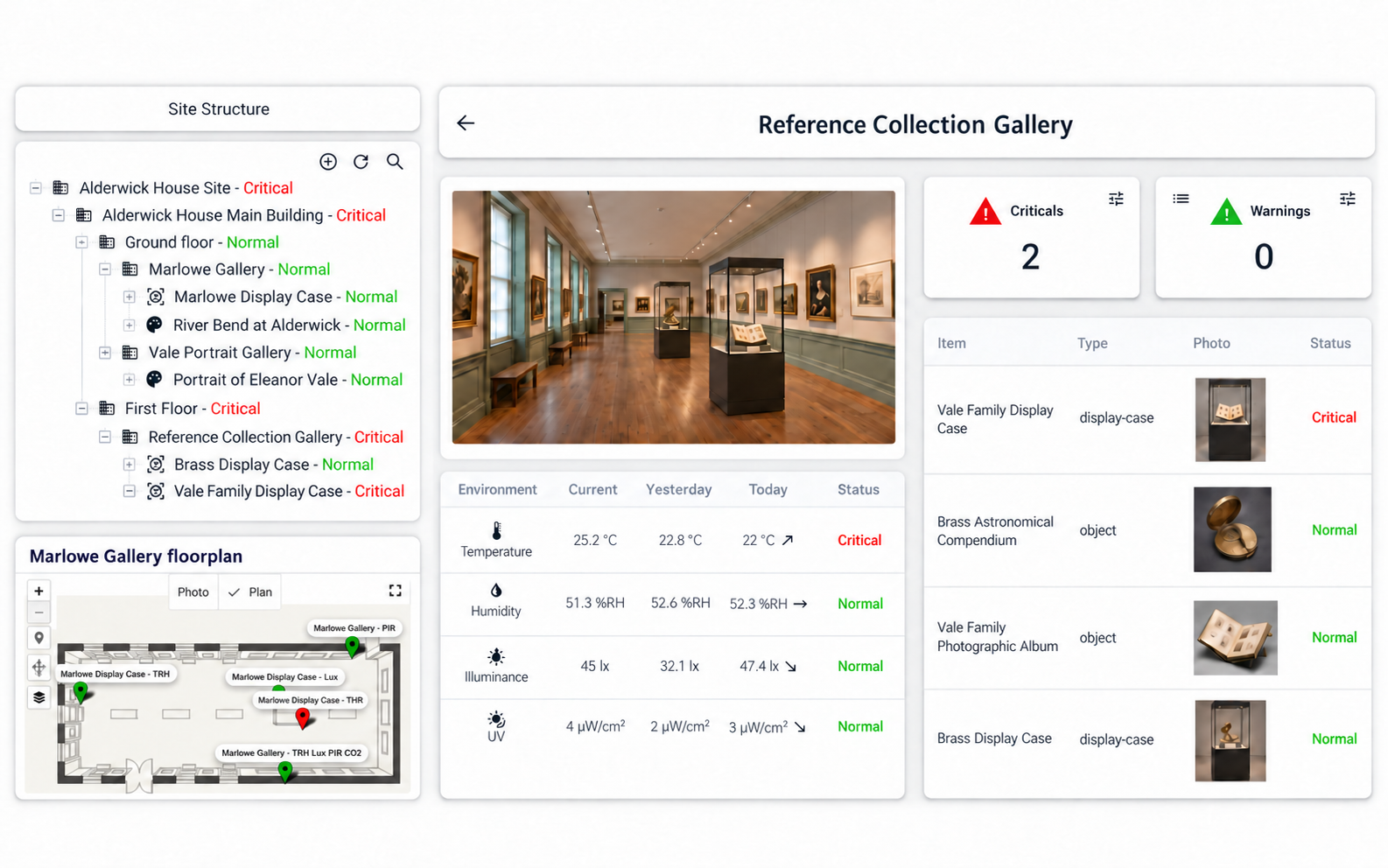
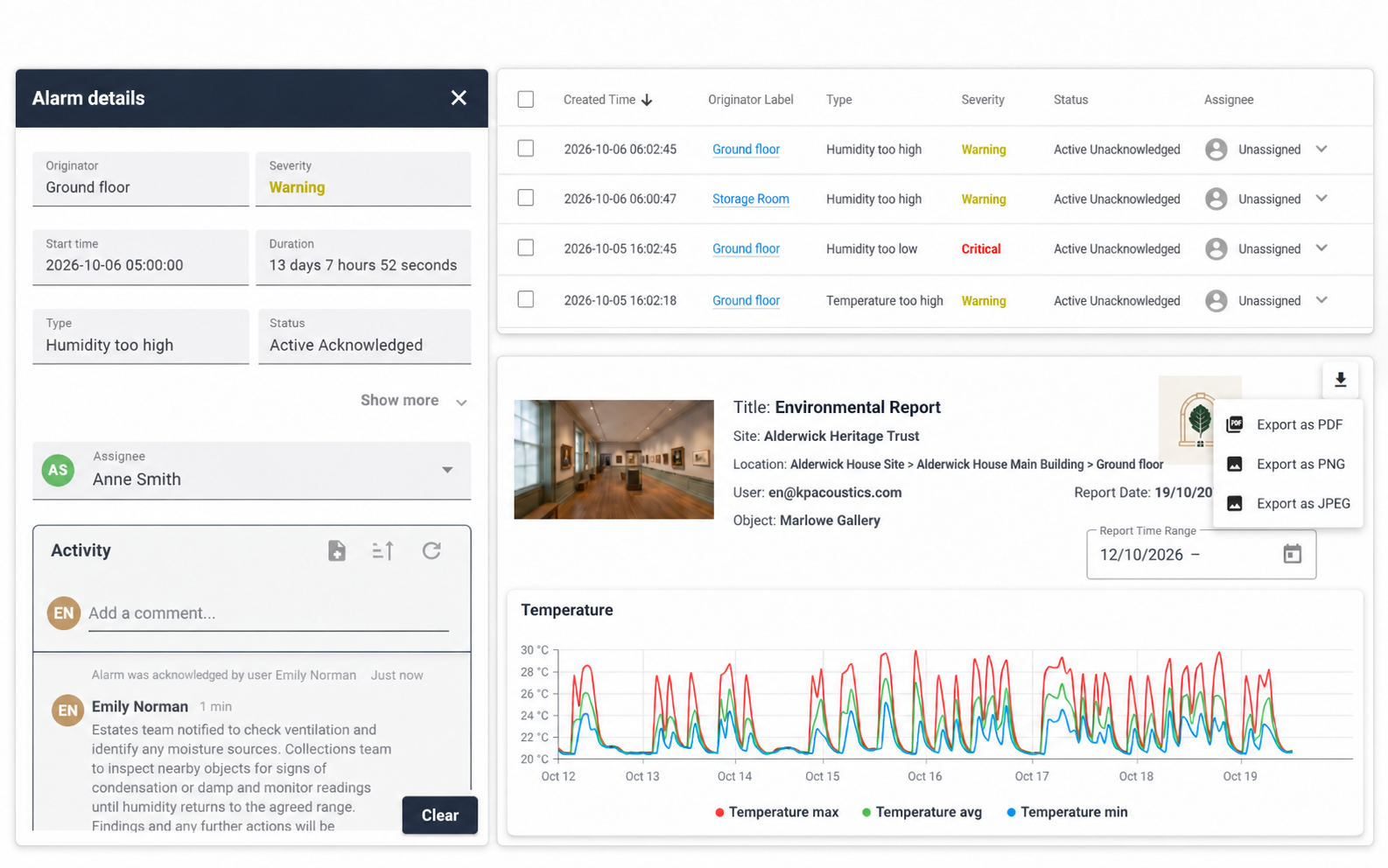
See where alerts need your attention.
Quickly locate environmental alerts and sensor connectivity issues across your site. Use your location structure and configured floorplans to identify the affected spaces and review readings in context.
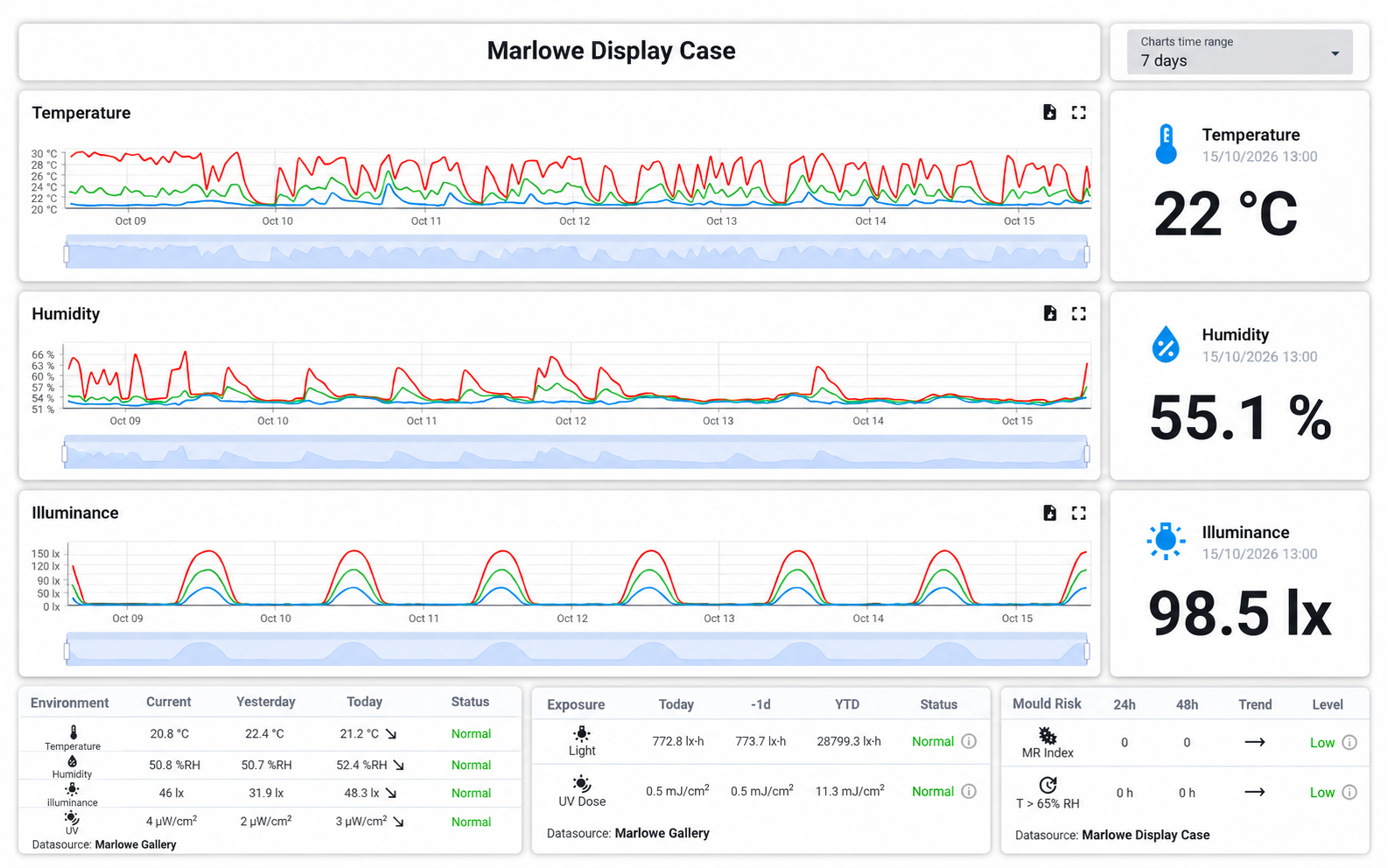
Make sense of change over time.
Review current and historical conditions. Compare sensor data, explore changes and investigate whether a pattern repeats. Configure thresholds and notifications around your monitoring priorities.
Investigate, collaborate and report.
Record observations, decisions and actions against each alert, creating a traceable record of responses. Build a clear audit trail that supports accountability across teams and individuals, with reports to evidence your response.
Beyond temperature and humidity
When something is being built next door.
Construction, transport and building services can introduce vibration into collection spaces. Understanding the risk requires more than installing a sensor and selecting a generic threshold.
Limits developed for buildings or human comfort do not, on their own, establish suitable limits for collection objects. The assessment needs to consider the object’s materials, condition, mounting and response, alongside the source and transmission of vibration.
KP Acoustics brings vibration engineering, monitoring and consultancy together. We work with your conservation and project teams to assess the setting, establish an appropriate monitoring approach and interpret the results.
Understand the baseline.
Establish existing vibration conditions before nearby works or operational changes, so subsequent activity can be assessed in context.
Agree a practical response.
Define monitoring locations, project-specific alert criteria, responsibilities and escalation arrangements with the teams involved.
Collections monitoring focuses on the conditions experienced by objects and their surroundings. Our Site & Compliance Monitoring services address construction noise, vibration and dust requirements; the two can be coordinated where a project needs both.
Discuss vibration risks
Designed around your organisation
Your priorities. Our expertise. A connected approach.
We work with your teams to understand what matters, from protecting collections to managing buildings and assets. Together, we shape the monitoring around your spaces, risks and operational needs, so the right information reaches the right people and supports confident decisions.
Together, we select or utilise the right sensors, connectivity and installation approach for your setting. We configure the system, train your teams and provide support tailored to your organisation, helping you get lasting value from your monitoring.
A package that fits your organisation.
Start with the coverage and support you need today, with scope to expand as your estate, team and requirements develop.
Focused monitoring
Essential
For smaller teams or a defined monitoring requirement. Bring environmental readings, alerts and reporting together with standard setup and support.
Best suited to: a focused collection, store, gallery or initial deployment.
Connected oversight
Portfolio
For organisations managing several sites or a wider sensor network. Give teams a shared view of conditions, with capacity for more devices and users.
Best suited to: multiple locations requiring coordinated monitoring and reporting.
Complex requirements
Enterprise
For larger estates and more demanding requirements. Combine greater capacity with priority support and options for dedicated hosting and tailored integrations.
Best suited to: organisation-wide deployments with more complex operational or IT needs.
Build on what you have.
We assess compatible existing sensors and supported integrations before agreeing where existing and new monitoring can connect.
Plan for continuity.
Historical data migration, connectivity and installation requirements are reviewed during scoping, based on your existing systems and available data.
Find the right approach
Experience & confidence
Monitoring expertise. Confidence in delivery.
KP Acoustics combines decades of collective expertise in monitoring, consultancy, research, testing and technology design, supported by our own research and testing facility in Southampton. Our multidisciplinary teams work across environmental and structural monitoring, from air quality, noise and vibration to temperature, humidity, CO₂, light and UV, with the expertise to deliver in highly sensitive, complex environments.
Together with IoT Squad, our capabilities extend across energy, smart buildings and connected infrastructure. We work alongside your teams to understand your needs, integrate the right technologies and create dependable systems that can evolve with your organisation.
Live V&A tender trial.
A live trial formed part of the Victoria and Albert Museum environmental monitoring procurement, providing a setting to demonstrate the monitoring proposition in use.
Framework appointment.
KP Acoustics is one of five suppliers appointed to the Victoria and Albert Museum Environmental Monitoring Systems Framework. Individual call-offs are subject to its terms.
Monitoring explained
Frequently asked questions
From collection conditions and loan requirements to installation, reporting and ongoing support.
What relative humidity should a museum store be kept at?
There is no single relative humidity setting suitable for every museum store. A range of 40–60% RH is commonly used for many collections, but appropriate limits depend on the materials, their condition and environmental history. Some objects require more specific conditions.
Agree targets and acceptable fluctuations with your conservator, and monitor conditions where the collections are stored, including any cases or cabinets with a separate microclimate. Loan agreements may specify additional requirements.
How often should environmental conditions be recorded?
Temperature and relative humidity should be recorded automatically throughout the day and night, at intervals short enough to capture changes relevant to your collection. The recording interval should reflect the risks, the space and any lender requirements.
Recording frequency is different from download frequency. A logger downloaded quarterly may hold frequent readings, but those readings cannot support a timely response until someone reviews them. Connected monitoring makes readings and configured alerts available between routine reviews, helping your teams respond sooner.
Can sensors be installed in a listed building without consent?
Sometimes, but wireless or removable equipment is not automatically exempt. In England, listed building consent is required for alterations that affect a building’s special architectural or historic interest. The proposed locations, fixings, cabling and effect on historic fabric all matter.
Freestanding sensors may avoid alterations, while drilling or attaching equipment to sensitive surfaces needs careful assessment. Check the proposed installation with your local planning authority’s conservation officer before work begins. Different consent arrangements apply elsewhere in the UK.
What monitoring evidence is needed for an indemnified loan?
For a loan covered by the Government Indemnity Scheme, expect to demonstrate suitable environmental conditions and arrangements for monitoring them throughout the loan. Published conditions include monitoring temperature, relative humidity and light levels in the space containing the object.
Lenders may also request pre-loan environmental records and a facilities report, with additional requirements for particular objects. Confirm the required recording period, limits and reporting format early: there is no single monitoring report that guarantees approval for every loan.
How many sensors does a gallery need?
There is no reliable sensor count based on floor area alone. Coverage should reflect the gallery’s layout, collection locations and environmental differences, including separate rooms, display cases and areas affected by sunlight, external walls or heating and ventilation.
An initial survey and baseline monitoring help identify where additional sensors are needed. We work with your teams to establish suitable coverage, so meaningful differences in conditions are captured rather than assuming one reading represents the whole gallery.
How long do the batteries last?
Battery life depends on the sensor model, what it measures, how frequently it records and transmits, and the conditions in which it operates. There is no single battery-life figure across a mixed monitoring system.
We confirm the manufacturer’s expected battery life for the selected devices and configuration during scoping, alongside replacement requirements and maintenance arrangements.
Can we keep our existing sensors?
Yes, in most cases. Our platform can incorporate a wide range of sensors, provided the manufacturer supports third-party integration. Hundreds of sensor models are already configured, and our developers can build additional integrations where needed.
We review your existing equipment and its integration options before recommending what can be retained and where additional monitoring would be useful.
Can you import our historical data?
Yes. Historical monitoring data can be imported from CSV files, preserving your original readings and timestamps. The import tool matches your data to the relevant sensors and parameters, with a preview to check everything before importing.
Once imported, historical records can be viewed alongside live readings in graphs, reports and exports, helping you maintain a continuous environmental record.
Can one platform cover several sites or stores?
Yes. Manage multiple sites in one platform, with a clear structure for each site’s buildings, rooms, display cases and collection objects.
Compare conditions across locations and report across your estate, while tailoring access and alerts so local teams see what matters to them and central teams retain wider oversight.
What will our IT team need to consider?
We work with your IT team to agree a straightforward setup that fits your existing network and security requirements. Together, we confirm connectivity, user access and any integrations you need, with clear guidance and support throughout.
Which package is right for us?
Essential suits smaller teams or focused monitoring requirements, bringing together environmental readings, alerts and reporting with standard setup and support.
Portfolio suits organisations managing several sites or a wider sensor network, giving teams a shared view of conditions with capacity for more devices and users.
Enterprise supports larger estates and more complex requirements, with greater capacity, priority support and options for dedicated hosting and tailored integrations.
We work with you to choose the right fit for your locations, team and future plans. Additional asset management and managed support can be included where needed.
What happens to our data if we stop?
Your environmental record should remain useful beyond the life of a service agreement. Before you commit, we explain how your readings can be exported, which information is included and what happens when the service ends.
Export arrangements, any associated costs, and the periods for continued access, retention and deletion are set out in your agreement, so you can plan for continuity from the outset.
How do we begin?
Start with the collection, space or deadline you need to support. Tell us about your locations, existing monitoring and any upcoming loans, exhibitions, building works or reporting requirements.
We will review your priorities with you and agree a suitable scope, including sensors, connectivity, installation, reporting and support.
Call 0208 222 8778 or visit the enquiry section below to arrange an initial discussion.
Start with your estate
Put your monitoring priorities into practice.
Preparing for a loan, planning building works or reviewing your existing monitoring? Talk to us about the evidence, coverage and support you need.
Book a demonstration to explore the platform in the context of your spaces, collections and operational priorities.
Call 0208 222 8778 or send us your requirements using our contact page.
Send an enquiry
Introducing TERESIS.
Environmental & Asset Intelligence.
TERESIS is our dedicated company for connected monitoring and asset intelligence, building on KP Acoustics Group’s expertise in consultancy, monitoring, research and technology design.
From collections and heritage to facilities and connected infrastructure, we bring sensor data, locations and assets together to support informed decisions and dependable long-term monitoring.
Delivered by KP Acoustics, powered by SmartWhere®.