Experience & confidence
Monitoring expertise. Confidence in delivery.
KP Acoustics combines decades of expertise in monitoring, consultancy and technology design. Our multidisciplinary teams work across environmental and structural monitoring, covering air quality, noise and vibration through to temperature, humidity, CO2, light and UV, with the experience to deliver in sensitive, complex environments.
That matters most where the numbers have to be defended. Limits written for buildings or for human comfort do not establish a safe level for a collection object: the assessment has to consider the object’s materials, condition, mounting and response, alongside the source and transmission of the vibration. We work with your conservation and project teams to agree an appropriate monitoring approach and interpret the results.
The platform is delivered with our technology partner IoT Squad and powered by SmartWhere®. Teresis is the dedicated company we have built around this work. It covers environmental monitoring for collections, interiors and the buildings that hold them.
Where a project also needs construction noise, vibration and dust monitoring, our Site & Compliance Monitoring service covers it and the two can be coordinated.

Live V&A tender trial
A live trial formed part of the Victoria and Albert Museum environmental monitoring procurement, providing a setting to demonstrate the monitoring proposition in use.
Framework appointment
KP Acoustics is one of five suppliers appointed to the Victoria and Albert Museum Environmental Monitoring Systems Framework. Individual call-offs are subject to its terms.
Planning ahead
Monitoring usually starts with a deadline
Most organisations start because something has a date attached. Begin early enough to build a useful record and address any gaps before it matters.
- A collections review, accreditation submission or insurer request
- A capital project, while monitoring can still go into the specification
- Construction, new plant or changed activity nearby
- Changes to heating, ventilation, occupancy or room use
Discuss your deadline
Your EMS
What the platform does
Your Environmental Monitoring System (EMS) brings readings, locations and the collections they affect into one place.
See where alerts need your attention
Quickly locate environmental alerts and sensor connectivity issues across your site. The location structure and floorplans identify which spaces are affected.
Make sense of change over time
Review current and historical conditions. Compare sensors, explore changes and investigate whether a pattern repeats. Configure thresholds and notifications to suit each space.
Investigate, collaborate and report
Record observations, decisions and actions against each alert, creating a traceable record of responses and evidence-based reports.
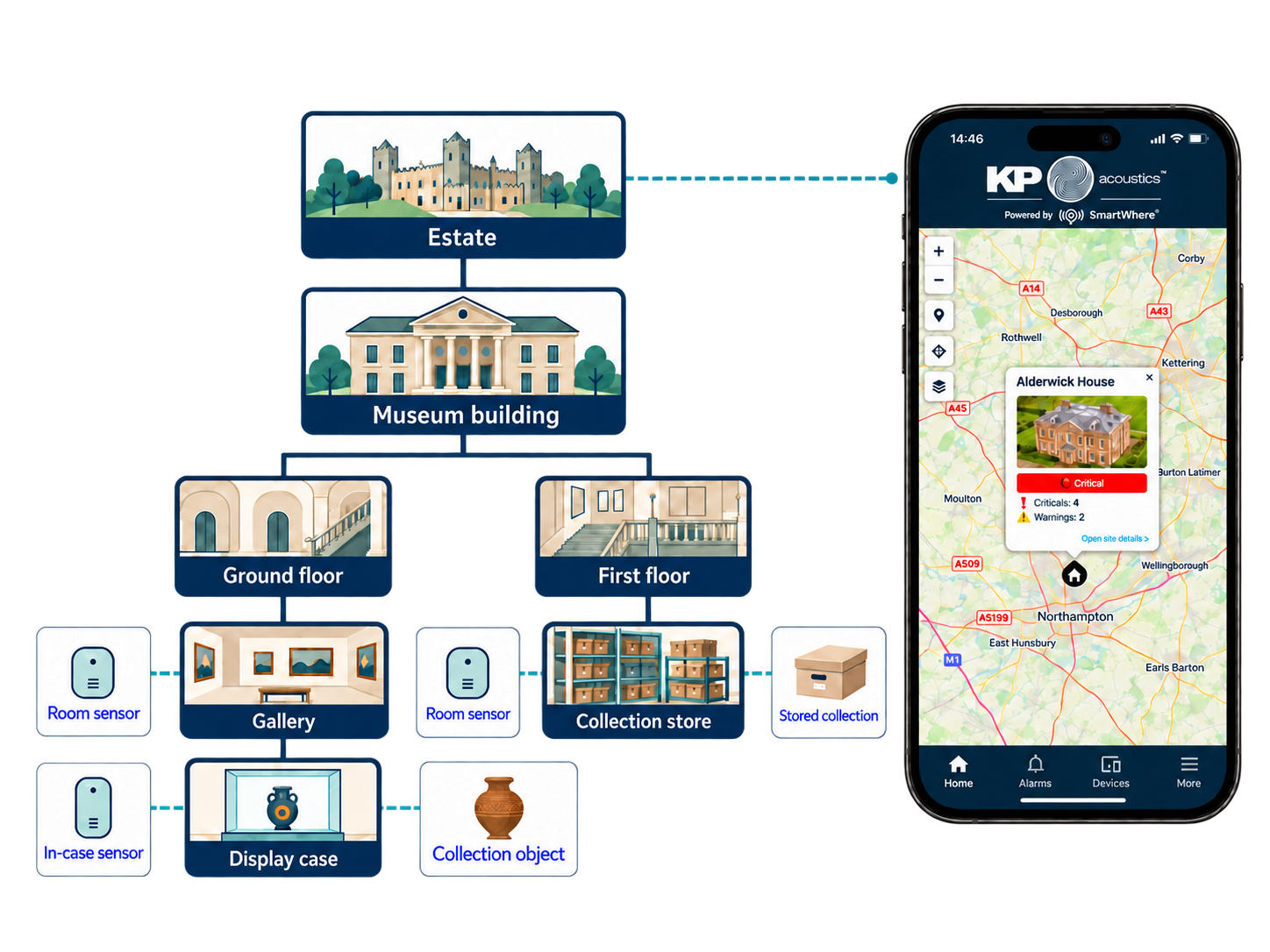
Estate-wide visibility
One view across the estate
Organise monitoring around your sites, buildings, floors, rooms and display cases. Connect environmental readings with the locations and collection objects they relate to.
Compatibility & continuity
Build on the monitoring you already have
Build on what you have
Compatible existing sensors are brought into the same platform and historical data is migrated where it can be read. New devices go into the gaps rather than over the top of equipment that still works.
Plan for continuity
Plan for continuity from the outset, with clear arrangements for accessing and exporting your environmental record. Export formats, access, retention and any associated costs are confirmed in your agreement.
Scope & scale
A package that fits your organisation
Packages scale around your sensors, managed assets and users. Allowances are confirmed in the proposal, with room to grow.
| Package comparison | Single site | Multi-site | Estate |
|---|---|---|---|
| For | A focused deployment in one building | Monitoring across more spaces, sites and teams | Larger estates and more complex arrangements |
| Sensor network | Focused | Broader | Extensive |
| Spaces & asset records | A smaller number | More locations | Larger volumes |
| Users | Core operational team | Greater capacity | Greater user and administrator capacity |
| Support | Standard platform support | Standard platform support | Priority platform support |
Book a technical walkthrough
Practical questions
Frequently asked questions
Practical guidance on collection conditions, installation, compatibility, reporting and ongoing support.
What relative humidity should a museum store be kept at?
There is no single correct setting. The safest reference point is the climate the collection has already acclimatised to, which is the principle behind BS EN 15757. Many organisations still work within the 40 to 60% band inherited from older guidance, but the appropriate limits depend on the materials, their condition and their history. Targets should be agreed with a conservator, and loan agreements may impose requirements of their own.
How often should environmental conditions be recorded?
Environmental conditions should be recorded automatically at intervals suited to the parameters being monitored, the risks in the space and any lender requirements. Readings are typically transmitted every 15 minutes in this application, balancing monitoring needs with battery life. The platform provides remote access to the latest received data, with automated alerts when those readings breach agreed thresholds.
Can sensors be installed in a listed building without consent?
Sometimes, but it cannot be assumed. Wireless or removable equipment is not automatically exempt, and listed building consent may be required depending on how the equipment is fixed and routed. Fixings and cabling are usually the deciding factor, so the proposal should be checked with the local conservation officer before installation.
How many sensors does a gallery need?
No reliable number can be derived from floor area alone. Coverage depends on the layout, where the collection sits, and the differences within a space created by sunlight, external walls, heating and ventilation. An initial survey and a period of baseline monitoring establish where sensors need to go.
How long do the batteries last?
It depends on the device, what it measures, how often it records and transmits, and the conditions it operates in. The expected life for the devices proposed is confirmed during scoping, so replacement can be planned into your maintenance routine.
Can we keep our existing sensors?
In most cases, yes, provided the manufacturer supports third party integration. We review the equipment you already have before recommending what to keep and where new monitoring is needed.
Can you import our historical data?
Yes. Historical readings can be imported from CSV, preserving the original values and timestamps, with a preview before anything is committed. Past records then sit alongside live readings in the same view.
Can one platform cover several sites or stores?
Yes. Multiple sites are managed in a single platform, structured by building, room, display case and object. Conditions can be compared across locations, and access and alerts can be set differently for each team.
What will our IT team need to consider?
The setup is agreed with your IT team to fit your network and security requirements. Connectivity, user access and any integrations are confirmed before installation, with support throughout.
What is the difference between the Single site, Multi-site and Estate packages?
Mainly capacity: the number of connected sensors, managed spaces, asset records, and the number of users. Single site suits one building or store. Multi-site suits several locations and the teams working across them. Estate suits large portfolios and includes priority support.
What happens to our data if we stop?
Your data belongs to you. If you decide to stop using the service, you can export all your data in CSV format to keep for your records or use elsewhere. We’ll help you plan the handover and agree when access ends and how any remaining data is retained or deleted.
How do we begin?
Tell us the collection, space or deadline you need to support, along with your locations, any monitoring already in place, and upcoming loans, works or reporting requirements. We agree a scope from there. Call 0208 222 8778, email info@kpacoustics.com or use the enquiry link below.
Start here
Start with your estate
Tell us about your spaces, existing monitoring and what your teams need to evidence. Book a technical walkthrough to explore the right approach.
Call 0208 222 8778, email info@kpacoustics.com or send us your requirements using the enquiry link below.
Send an enquiry